
Ivan M. Martinez, SE-AWMA, CRPC
Senior Financial Advisor
Email Address
ivan.m.martinez@wellsfargo.comPhone Number
(281) 232-1882Toll Free
(866) 281-7436Find Me On
I believe that communication is instrumental to success in managing life's challenges. That's why I work to engage families in the financial decision-making process. Communicating openly with family members on the sometimes difficult subject of wealth can be a challenge. I can help facilitate these discussions and offer opportunities to educate the younger generation about how assets may be invested.
My Professional Experience Prior to joining Wells Fargo in September 2023, I held a Wealth Management practice at Merrill since 2016 and was part of the consumer banking division at Bank of America since 2012. As a Senior Financial Advisor at Wells Fargo I offer advice based on your goals and priorities– for yourself, your family, and your business. Our goals-based wealth management approach places the investor at the center of our focus, not the market. I can help you understand the pros and cons of every decision and maintain discipline so you can pursue your goals. As your needs or market conditions change, I will continue to work with you to agree upon adjustments to your investment approach.
When I am not in the office, I enjoy spending time outdoors with my daughter, Avril. You can find us hiking, kayaking, attending sporting events or out at the dog park with Dobby, our German Shepperd and Cane Corso, Ash.
Contact Me if:
- You want to hear more about our wealth management process
- You would like me to help you develop strategies for pursuing your financial goals.
- You are a CPA or attorney interested in providing a resource for your clients
Certificates
SE-AWMA, CRPC
Education
- University of Houston-Clear Lake
Languages
- Spanish
Our Resources

eMoney Advisor®
A modernized approach to advice
Leveraging our industry leading advice tools and resources simplifies the planning process and allows you to track closer to your desired outcomes.
Investment expertise and advice in an effort to help clients succeed financially
Wells Fargo Investment Institute




Alternative Investment Opportunities
- Historically lower market correlation compared to traditional investments
- Less-extreme market cycle peaks and troughs
- Access to more investment opportunities
If this interests you, we can create a plan with alternative investment allocations as part of your overall investment strategy to unlock potentially significant opportunities.
Alternative Investments: Upside That Can Limit Downside Exposure
From 1990 through the end of 2023, hedge funds have helped investors navigate difficult markets by experiencing significantly fewer negative months than equities.
Equities have experienced a much bumpier ride than hedge funds:
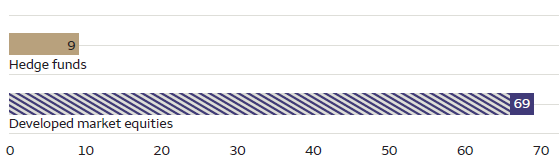
Source: MPI Stylus. Numbers indicate months with returns of less than -3%. Data based on historical performance from January 1, 1990, through December 31, 2022. Hedge funds are represented by the HFRI Fund Weighted Composite Index. Developed market equities are represented by the MSCI World Index.For illustrative purposes only. Index returns do not represent fund performance or the results of actual trading. Index returns reflect general market results; assume the reinvestment of dividends and other distributions; and do not reflect deduction of fees, expenses, or taxes applicable to an actual investment. Unlike most asset class indexes, HFR Index returns reflect deduction for fees. Because the HFR Indexes are calculated based on information that is voluntarily provided, actual returns may be lower than those reported. An index is unmanaged and not available for direct investment. Past performance is no guarantee of future results.
Alternative investments, such as hedge funds, funds of hedge funds, managed futures, private capital, real assets and real estate funds, are not appropriate for all investors. They are speculative, highly illiquid, and are designed for long-term investment, and not as trading vehicle. These funds carry specific investor qualifications which can include high income and net-worth requirements as well as relatively high investment minimums. The high expenses associated with alternative investments must be offset by trading profits and other income which may not be realized. Unlike mutual funds, alternative investments are not subject to some of the regulations designed to protect investors and are not required to provide the same level of disclosure as would be received from a mutual fund. They trade in diverse complex strategies that are affected in different ways and at different times by changing market conditions. Strategies may, at times, be out of market favor for considerable periods with adverse consequences for the fund and the investor. An investment in these funds involve the risks inherent in an investment in securities and can include losses associated with speculative investment practices, including hedging and leveraging through derivatives, such as futures, options, swaps, short selling, investments in non-U.S. securities, “junk” bonds and illiquid investments. The use of leverage in a portfolio varies by strategy. Leverage can significantly increase return potential but create greater risk of loss. At times, a fund may be unable to sell certain of its illiquid investments without a substantial drop in price, if at all. Other risks can include those associated with potential lack of diversification, restrictions on transferring interests, no available secondary market, complex tax structures, delays in tax reporting, valuation of securities and pricing. An investment in a fund of funds carries additional risks including asset-based fees and expenses at the fund level and indirect fees, expenses and asset-based compensation of investment funds in which these funds invest. An investor should review the private placement memorandum, subscription agreement and other related offering materials for complete information regarding terms, including all applicable fees, as well as the specific risks associated with a fund before investing.