Your Goals and Dreams, Our Guidance
- Your investments are important. Advisory Services can help them receive the care they deserve.
- Your investments can be professionally managed or a Financial Advisor can help you manage them yourself.
- Wells Fargo Advisors programs allow flexibility to help you reach your goals.
Managing investments
A lot may be riding on your investments: retirement, children’s or grandchildren’s education, your financial legacy. Your investment plan should get the attention it deserves.Some investors enjoy managing their own plan. They are confident in their abilities and have the time to research and monitor their investments’ performance.
You’re not alone if you don’t fall into that category. Like many others, you may want to work with a professional by taking advantage of an advisory program.
Using an advisory program
You can save time and have a professional manage your investments when you use the services of an advisory program.Advisory programs generally fall into two categories. One gives another party the power to make decisions for your account’s day-to-day management. This means you can allow a portfolio manager — in some cases your Financial Advisor — to decide when to buy, sell, and hold investments without consulting you.
Your portfolio manager will make decisions based on a variety of factors:
- Your long-term objectives
- The time you have to reach your objectives
- Your risk tolerance
In the other program, you collaborate with your Financial Advisor. We will provide you with objective advice and guidance based on your needs, goals, and today’s investment environment, to help you make your own buy, sell, and hold decisions.
Fee replaces commissions
So how can an advisory account differ from a traditional brokerage account? One difference is how you pay for the services you receive. In an advisory account program, you generally pay a fee. This is often charged on a quarterly basis based on a percentage of your account’s value. In a traditional brokerage account you would pay a commission for each transaction.
Flexible range of alternatives
You can choose which advisory services program you implement. Wells Fargo Advisors offers an array of programs. You can decide what products you would like to have managed, such as mutual funds, exchange-traded funds (ETFs), stocks, bonds, and commodity-based investments.
We can discuss the programs with you and see what fits your situation – and what makes you feel more confident in helping you reach your goals.
Next steps
Decide if you would like some extra help with making your investment decisions.
Make an appointment to talk with us about advisory accounts.
The fees for advisory programs are asset-based and assessed quarterly in advance. There may be a minimum fee to maintain this type of account. Fees include advisory services, performance measurement, transaction costs, custody services, and trading. These fees do not cover the fees and expenses of any underlying exchange traded fund (ETF), closed-end funds, or mutual funds in the portfolio. Advisory accounts are not designed for excessively traded or inactive accounts and are not appropriate for all investors. Please carefully review the Wells Fargo Advisors advisory disclosure document for a full description of our services, including fees and expenses. The minimum account size for these programs is between $10,000 and $2,000,000.
Creating a plan can help you stay focused, plan for challenges, and make choices that work for you. Find out how to create and manage your retirement plan.
- Everyone could use an estate plan – not just the wealthy.
- 5 documents are essential for many estate plans.
- An estate planning attorney and your accountant will work with your Financial Advisor.
Estate planning: a matter of control
You might associate estate planning with famous people you see in the news. In fact, estate planning could be appropriate for everyone.Consider your assets: bank accounts, investment accounts, 401(k) or 403(b) plan accounts, house, cars, jewelry, and heirlooms. This is your estate and your estate plan can define what you would like to happen to these assets when you die.
An estate plan can also take care of you as you get older or if you become ill or incapacitated. Being wealthy has little to do with it.
If you don’t make your own plan, your family may be left scrambling at an already difficult time. Bottom line: If you don’t decide, someone will decide for you.
Five essential documents
These five documents are often essential to an estate plan:- Will - Instructions for distributing your assets when you die. You will name a personal representative (executor) to pay final expenses and taxes and distribute remaining assets. Name a guardian to raise your minor children if both parents die.
- Durable power of attorney – You give a trusted individual management power over your assets if you can’t manage them yourself. This document is effective only while you’re alive.
- Health care power of attorney - You choose someone to make medical decisions on your behalf if something were to happen and you can’t make them yourself.
- Living will – Shares your intentions about life-sustaining medical measures if you are terminally ill. No one is given authority to speak for you.
- Revocable living trust - You can provide for continued management of your financial matters while you are alive, after your death, and even for generations after.
Why beneficiary designations are important
Beneficiary designations can be an easy way to transfer an account or insurance policy when you die. But if you didn’t complete beneficiary designations, or haven’t updated them, they can cause issues with your estate plan.Designations on forms are often filled out without much thought – but they’re important and deserve your attention. Beneficiary designations on forms like your insurance policy and 401(k) take priority over other estate planning documents, like your will or trust.
Let’s say you specify in your will you want everything to go to your spouse after your death. But you never changed the beneficiary designation on your life insurance policy and it names your ex-spouse. Your ex may end up getting the proceeds.
Turn to a team of professionals
Making the decisions involved with estate planning may seem overwhelming. It doesn’t have to be. You can start by organizing your important documents.Turn to a team of trusted professionals, including your financial advisor, an estate planning attorney, and your accountant. They know the questions to ask and can help you avoid potential pitfalls.
If you currently don’t have relationships with an attorney and an accountant, we can make some recommendations. We can also discuss our role in the planning process and how you can get started.
Next steps
- Make an appointment with us to talk about your estate planning goals.
- Start gathering your financial documents.
- Check the beneficiary designations on your financial and investment accounts.
Trust services available through banking and trust affiliates in addition to non-affiliated companies of Wells Fargo Advisors.
Wells Fargo Advisors and its affiliate do not provide tax or legal advice. Please consult with your tax and/or legal advisors before taking any action that may have tax and/or legal consequences. Any estate plan should be reviewed by an attorney who specializes in estate planning and is licensed to practice law in your state.
Passing along your legacy to the next generation can seem like a daunting task with many tactics, roles and guidelines to consider.
At Our Firm, we provide access to Wells Fargo Bank Estate Services to help our clients with their trust and estate planning needs. As one of the leading national providers of estate settlement services, Wells Fargo Bank, N.A. can help you pass your legacy on to your beneficiaries.
Click to Learn More
Wells Fargo Wealth Management provides products and services through Wells Fargo Bank, N.A. and its various affiliates and subsidiaries. Financial Advisors of Wells Fargo Clearing Services may refer clients to the bank for an ongoing or one-time fee. Wells Fargo & Company and its affiliates do not provide legal advice. Please consult your legal advisors to determine how this information may apply to your own situation. Whether any planned tax result is realized by you depends on the specific facts of your own situation at the time your taxes are prepared.
Mutual funds, bonds and individual stocks have their places in most portfolios. But if you are open to other avenues for growth potential, alternative investments such as hedge funds and private debt might provide these benefits for your investment plan:
- Historically lower market correlation compared to traditional investments
- Less-extreme market cycle peaks and troughs
- Access to more investment opportunities
If this interests you, we can create a plan with alternative investment allocations as part of your overall investment strategy to unlock potentially significant opportunities.
Alternative Investments: Upside That Can Limit Downside Exposure
From 1990 through the end of 2022, hedge funds have helped investors navigate difficult markets by experiencing significantly fewer negative months than equities.
Equities have experienced a much bumpier ride than hedge funds:
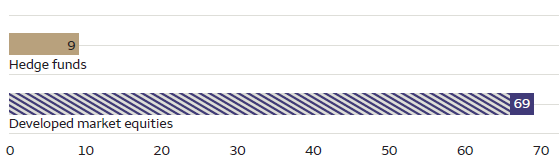
Source: MPI Stylus. Numbers indicate months with returns of less than -3%. Data based on historical performance from January 1, 1990, through December 31, 2022. Hedge funds are represented by the HFRI Fund Weighted Composite Index. Developed market equities are represented by the MSCI World Index.For illustrative purposes only. Index returns do not represent fund performance or the results of actual trading. Index returns reflect general market results; assume the reinvestment of dividends and other distributions; and do not reflect deduction of fees, expenses, or taxes applicable to an actual investment. Unlike most asset class indexes, HFR Index returns reflect deduction for fees. Because the HFR Indexes are calculated based on information that is voluntarily provided, actual returns may be lower than those reported. An index is unmanaged and not available for direct investment. Past performance is no guarantee of future results.
Alternative investments, such as hedge funds, funds of hedge funds, managed futures, private capital, real assets and real estate funds, are not appropriate for all investors. They are speculative, highly illiquid, and are designed for long-term investment, and not as trading vehicle. These funds carry specific investor qualifications which can include high income and net-worth requirements as well as relatively high investment minimums. The high expenses associated with alternative investments must be offset by trading profits and other income which may not be realized. Unlike mutual funds, alternative investments are not subject to some of the regulations designed to protect investors and are not required to provide the same level of disclosure as would be received from a mutual fund. They trade in diverse complex strategies that are affected in different ways and at different times by changing market conditions. Strategies may, at times, be out of market favor for considerable periods with adverse consequences for the fund and the investor. An investment in these funds involve the risks inherent in an investment in securities and can include losses associated with speculative investment practices, including hedging and leveraging through derivatives, such as futures, options, swaps, short selling, investments in non-U.S. securities, “junk” bonds and illiquid investments. The use of leverage in a portfolio varies by strategy. Leverage can significantly increase return potential but create greater risk of loss. At times, a fund may be unable to sell certain of its illiquid investments without a substantial drop in price, if at all. Other risks can include those associated with potential lack of diversification, restrictions on transferring interests, no available secondary market, complex tax structures, delays in tax reporting, valuation of securities and pricing. An investment in a fund of funds carries additional risks including asset-based fees and expenses at the fund level and indirect fees, expenses and asset-based compensation of investment funds in which these funds invest. An investor should review the private placement memorandum, subscription agreement and other related offering materials for complete information regarding terms, including all applicable fees, as well as the specific risks associated with a fund before investing.
- Saving for your child’s or grandchild’s education doesn’t have to derail your retirement savings plan.
- 529 plans and trust funds are designed to help save for a child’s education.
- Financial aid may be another option
Retirement vs. education
As a parent or grandparent, you’re probably considering how to balance paying for college while planning for your retirement. Many families use some combination of savings, investments, borrowing, and financial aid (if available).There are options for financing college, but Wells Fargo Advisors believes saving for retirement should be the higher priority for many investors.
If your employer offers a 401(k) plan, consider putting your savings there first, especially if there is a company match. After that, contribute to your child’s education account.
Save as early as possible
As you can imagine, the sooner you start saving for your child’s or grandchild’s education, the more money you may have later.One popular way to save is the 529 college savings plan. These are tax-advantaged accounts administered by states and institutions. Parents, grandparents, relatives, and friends can contribute.
Other college savings accounts include custodial accounts in the child’s name and Coverdell Education Savings Accounts.
Please consider the investment objectives, risk, charges and expenses carefully before investing in a 529 savings plan. The official statement, which contains this and other information, can be obtained by calling your Financial Advisor. Read it carefully before you invest.
Qualified Coverdell Education Savings Account distributions are not subject to state and local taxation in most states.
Establish an educational trust fund
Setting up an educational trust fund designed for your child’s education is also an option. When a grandparent or benefactor establishes an education trust, the terms of the trust can be specified. This can include who controls the money, how it will be used, and for whom the trust benefits.It’s a good idea for grandparents to involve parents when it comes to helping with college savings. How they choose to save could impact any potential financial aid the child may receive.
Consider financial aid
A variety of factors play into financial aid eligibility. Don’t assume your child or grandchild won’t qualify for financial aid.Start thinking about applying for aid during high school. Visit the U.S. Department of Education’s Financial Aid Office for information about eligibility requirements, application deadlines, and types of federal financial loans and aid.
For nonfederal financial aid, visit the College Board’s College Scholarship Service (CSS)/Financial Aid PROFILE® application for information on qualifying.
Factor in income and existing investments
Other investment sources may help pay for college, and keep you from tapping your retirement savings. Those may include stocks, bonds, and mutual funds.It’s a balancing act
As you plan for the future, keep in mind the three C’s of college funding: consistency, communication, and compromise.Planning for retirement, managing your investment portfolio, and funding a college education is a balancing act. The trick is to plan ahead.
We can help you come up with a plan that considers all aspects.
Next steps
- Ask us how you can save for both retirement and education.
- Start saving for college when your child or grandchild is young.
- Even if you don’t think you’ll qualify, apply for financial aid.
Trust Services are available through Wells Fargo Bank, N.A. Member FDIC and Wells Fargo Delaware Trust Company, N.A. Wells Fargo Advisors and its affiliates do not provide legal or tax advice.
- Insurance is valuable for employees and owners.
- Owners get to retire, too.
- You can begin planning now for retirement, selling your company, or the event of your death.
Wells Fargo Advisors provides products and services, available through your Financial Advisor, that help you manage your assets and plan for the future.
Customized products and services for business owners
We are committed to helping you maximize the success and profitability of your business. Our specialized products and services can help give your business the cash flow and support it needs to thrive.Some of the services we offer and can assist with include:
Employee benefit plans and packages
A competitive employee benefit package helps you attract and keep employees, regardless of the size of your company.Business owner life insurance
As a business owner, it’s important to consider both replacing the income your family depends on, and also providing funds to pay off business-related liabilities.Funding a buy-sell agreement
If your business has more than one owner, you need to understand the risks you may face if one of you dies unexpectedly. A buy-sell agreement sets up how ownership of the business may be transferred if one owner dies.Key person life insurance
Proceeds from this type of business insurance can help offset the loss of sales your business would experience or expenses it may incur if a key person dies.Succession planning and business exit strategies
It can be helpful to start the succession planning and exit strategy process many years in advance.- Selling a business: There are many options to consider in both the sale and how you will generate income after the sale.
- Transferring the business to a family member: There are a variety of succession planning strategies you can use to transfer the business to a family member
Next steps
- Make an appointment with us to talk about your business needs.
- Talk with your family or partners about insurance or succession planning.
- Check the beneficiary designations on your financial and investment accounts.
Insurance products are offered through nonbank insurance agency affiliates of Wells Fargo & Company and are underwritten by unaffiliated insurance companies.